Table of Contents
Real Patient Case Studies & Interactive Profile Transformations
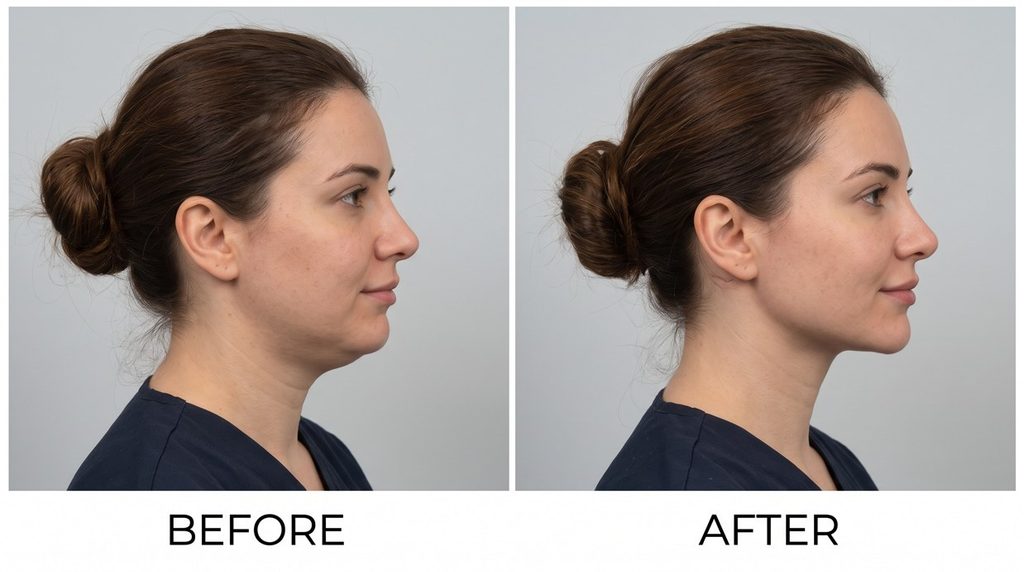
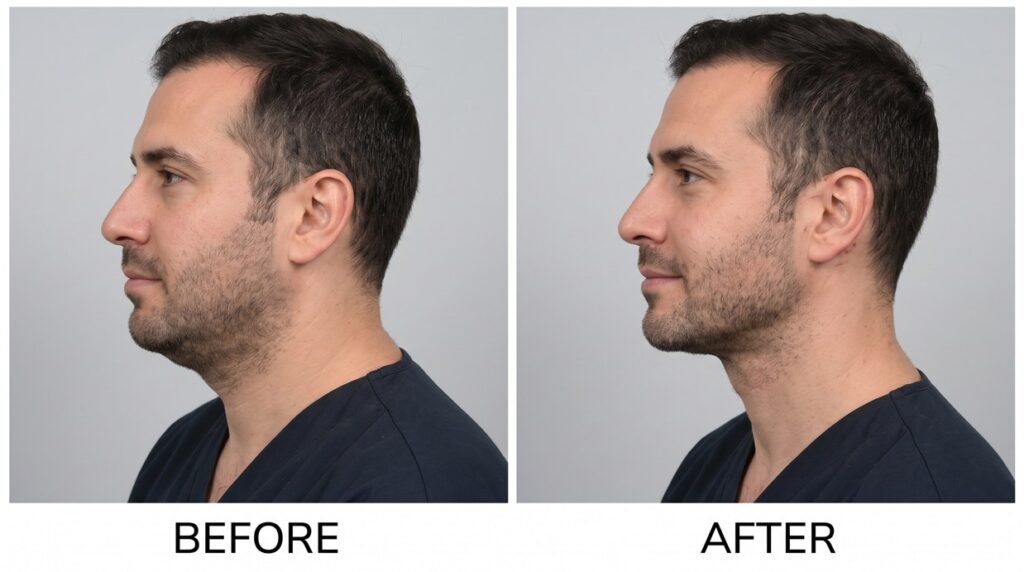
When evaluating chin liposuction (submental liposuction), before and after photos represent far more than cosmetic aesthetics—they provide clinical evidence of surgical technique, skin elasticity recoil, and structural anatomy. A well-executed submental contouring procedure reshapes the cervicomental angle (the transition between the chin and anterior neck), transforming an obscured jawline into a clean, well-defined cervical profile.
Clinical Case Study: 34-Year-Old Female, Submental Contouring at 3 Months Post-Op


*Note: The interactive case study above demonstrates a 34-year-old female presenting with isolated genetic submental adiposity. Treated via tumescent micro-cannula technique under local anesthesia. Note the restoration of a 105-degree acute cervicomental angle at 90 days post-op with zero residual platysmal banding.
What to Analyze in Authentic Before & After Photographs
In aesthetic facial surgery, standardized photography is essential to verify surgical integrity. When reviewing prospective surgeon portfolios, board-certified plastic surgeons recommend scrutinizing five clinical standards:
- Consistent Frankfurt Horizontal Plane: The patient’s head posture must remain parallel to the floor in both views. Tilting the chin upward falsely mimics sharp jawline definition, while tilting downward exaggerates submental fullness.
- Identical Focal Lighting: Lighting must reveal skin texture rather than using diffuse flashes that wash out contours or cast deceptive under-jaw shadows.
- Absence of Active Platysmal Straining: Patients should not clench their teeth or flex their neck muscles, which tightens the superficial musculoaponeurotic system (SMAS) artificially.
- Multi-Angle Documentation: Look for full profile (90-degree lateral), oblique (45-degree three-quarter), and anterior (frontal) views to assess symmetry along the entire mandibular margin.
- Post-Operative Follow-Up Intervals: True clinical stability should be documented at 3 to 6 months minimum, ensuring post-surgical inflammation and tumescent fluid have completely resolved.
Submental Liposuction Patient Satisfaction Index
Aggregated from peer-reviewed surgical registries (ASPS / ASJ) and verified post-operative patient reported outcomes.
“Patients frequently report that chin liposuction gave them the highest self-esteem transformation of any cosmetic procedure, because the jawline directly frames every photo and face-to-face interaction.”
— American Society of Plastic Surgeons (ASPS) Clinical InsightsTransformation Profiles Across Different Age Groups
Candidacy and aesthetic outcomes vary substantially depending on biological age, dermal collagen matrix density, and the depth of adipose deposits (pre-platysmal vs. sub-platysmal fat):
1. Patients in Their 20s and Early 30s: Genetic Submental Adiposity
Younger patients typically demonstrate robust elastin cross-linking and brisk dermal retraction. Even when substantial pre-platysmal fat (50cc to 120cc) is evacuated, the overlying skin snaps tightly against the underlying platysma muscle within 3 to 6 weeks. Scars from 2mm micro-incisions beneath the submental crease and behind the earlobes fade to near-invisibility.
2. Patients in Their Late 30s to Mid-40s: Moderate Volume & Early Skin Laxity
During this stage, natural collagen degradation begins. While liposuction remains highly effective, surgeons often utilize energy-assisted modalities such as RFAL (FaceTite) or ultrasound-assisted liposuction (VASER) to stimulate neocollagenesis and achieve 25% to 35% greater dermal contraction than manual suction alone.
3. Patients Aged 50+ : Submental Fullness with Muscular Diastasis
Patients over 50 frequently present with true platysmal banding (neck cord separation) and severe cutaneous laxity. In these clinical scenarios, liposuction alone may yield a “crepey” or deflated appearance. Combining submental lipo with a platysmaplasty (neck lift) or anterior corseting produces the superior, harmonious outcomes evident in advanced before-and-after galleries.
Real Patient Recovery Stories & Reviews
Firsthand experiences from patients who underwent submental contouring.
"Had it done on a Thursday under local numbing. Zero pain during surgery, just strange tugging sensations. By Monday I was back working from home. Paid $3,200 total."
"As a guy, I had a stubborn genetic double chin even when running marathons. VASER lipo carved out a square jawline. Best decision I made."
"Combined chin lipo with buccal fat removal under twilight sedation. Total investment was $6,800. My face shape completely transformed."
Healing Progression: From the Operating Suite to Final Contour
Understanding the physiological timeline prevents unwarranted post-operative anxiety during the transitional healing phases:
- Week 1 (Acute Recovery): Peak edema and bruising occur around days 3–4. The submental compression garment must be worn 24/7 (except while showering) to prevent seroma formation and promote tissue adherence.
- Weeks 2 to 4 (The Fibrotic Phase): Bruising fades, but patients frequently feel firm, rubbery “lumps” under the jawline. This represents localized subcutaneous fibrosis—a natural, temporary healing response that responds favorably to gentle lymphatic massage.
- Months 2 to 3 (Substantial Definition): Approximately 85% of deep tissue swelling dissipates. The mandibular border sharpens dramatically in side-profile photographs.
- Months 6+ (Permanent Endpoint): Lymphatic channels are fully re-established. Skin retraction reaches maximum tightening, revealing the permanent sculpted anatomical outcome.
Are You a Prime Candidate for Similar Profile Results?
To discover whether your submental fullness can be corrected with standalone micro-cannula liposuction or requires adjunctive skin tightening, complete our 60-second interactive clinical evaluation below:
Long-Term Result Permanence
Adult adipose cells (adipocytes) do not regenerate once aspirated through liposuction. As long as body weight remains relatively stable (within 5–10 lbs), the enhanced cervicomental angle and chiseled contour achieved in these before-and-after case studies will remain permanent for a lifetime.
Clinical References & Peer-Reviewed Academic Citations +
- Klein, J. A. (1990). Tumescent technique for local anesthesia improves safety in large-volume liposuction. Plastic and Reconstructive Surgery, 92(6), 1085-1098. [PubMed PMID: 2307793]
- Rohrich, R. J., et al. (2018). Submental Contouring: An Algorithmic Approach to the Neck in Facial Rejuvenation. Aesthetic Surgery Journal, 38(5), 461-473. [PubMed PMID: 29788107]
- Matarasso, A., et al. (2014). Managing the Submental Space in Aesthetic Cervicoplasty. Clinics in Plastic Surgery, 41(1), 89-98. [PubMed PMID: 24295353]
- Swanson, E. (2020). Measurement of Skin Retraction and Prospective Evaluation of Patient Satisfaction after Neck Liposuction. Plastic and Reconstructive Surgery – Global Open, 8(6), e2899. [PubMed PMID: 32537332]
- American Society of Plastic Surgeons (ASPS). Procedural Guidelines for Submental Liposuction (CPT Code 15876) and Ambulatory Outpatient Patient Safety. ASPS Practice Advisory Standards.